Seeing Enhanced Colours for the First Time: The Breakthrough Optometry Can’t Ignore
For decades, colour vision deficiency has been an overlooked topic within optometry — a condition so common, yet so silently carried, that millions of people move through life with a muted world of colour and a surprising amount of shame. But a groundbreaking innovation from Hungary is about to change everything.
In a recent conversation with COLORON, a company at the forefront of colour-vision research and filter-lens technology, I had the privilege of exploring the science, the story, and the enormous potential behind a breakthrough that could reshape optical practice forever.
This isn’t just about lenses.
It’s about dignity, confidence, and witnessing people see colours they’ve never seen before.
How a Tomato Puree Problem Sparked a Scientific Revolution
Unbelievably, the origins of this innovation begin with… tomato puree?
In the 1980s, East Germany rejected shipments of Hungarian tomato puree because it “wasn’t red enough.” But what is red enough? And how can you scientifically prove it?
The Hungarian government turned to a research team at the Technical University of Budapest. Professor György Ábrahám created the first “tomato purimeter” — a device that defined objective red through precise light-filtering science.
Once the project ended, the researchers realised they had unlocked something profound:
the ability to manipulate and measure red light with unprecedented accuracy.
This sparked a new question:
Could this be used to understand the human eye? Could it help people with colour vision deficiency?
And so began a multi-decade journey into the world of colour-vision science.
The Hidden Reality: Colourblindness Isn’t Rare — It’s Hidden
Most optometrists know the statistic:
1 in 12 men
1 in 200 women
…are colour-vision deficient.
But what most people don’t know is this:
Many patients hide it.
They feel embarrassed. Ashamed.
They’ve learned to cope by guessing, blending in, or quietly avoiding situations where colours matter.
Choosing fruit.
Choosing clothes.
Choosing careers.
COLORON’s team explained that even celebrities — such as Mark Zuckerberg — have openly acknowledged colour vision issues. Yet for the general public, it remains a silent struggle.
What struck me is that in optical practice, we rarely screen adults properly. Many practices don’t perform Ishihara on adults unless there’s a reason. And yet, this is a condition that deeply affects everyday life.
Now, for the first time, there is a meaningful, practical, affordable tool that gives these patients something they’ve never had:
A chance to experience enhanced colour.
The Science: Why Colour Vision Deficiency Happens
The research uncovered a surprising truth:
Colourblindness isn’t usually caused by a missing cone — it’s caused by a shift in the sensitivity of the red or green cone.
In simpler words:
Reds don’t appear fully red.
Greens don’t appear fully green.
Instead, colours collapse into a brownish-yellow “confusion zone.”
COLORON’s filter lenses don’t change the eye itself.
They change the stimulus — the light entering the eye — so the brain receives a cleaner, more distinct colour signal, allowing patients to distinguish colours they’ve never been able to separate before.
The Patient Experience: From “I See Nothing” to “I Can See It!”
The testing process is very simple.
Standard Ishihara test
Most patients can only guess 1–2 out of 12 plates.ColorOn’s patented digital tester
A 10–12 minute assessment that identifies their exact type and severity.Trial lenses
Patients try Mild, Experience, or Strong filters depending on their profile.Adaptation period
After 1–5 minutes, the brain recalibrates. Whites return to normal.Repeat Ishihara test
And suddenly — plates become visible for the first time.
Patients take the eyewear off and put it back on again, just to compare—and that’s when they really notice how differently they see without it.
Many laugh in disbelief.
Many simply go silent, taking in a world that was previously unavailable to them.
This is a development optometrists will talk about for years.
One Solution? Not Quite — Patients Need Options
ColorOn offers several filter types:
Strong Lens – maximum differentiation (e.g., design work, colour-critical tasks)
Experience Lens – strong enhancement for everyday use
Mild Lens – light, gentle enhancement
Sunglass Filter – outdoor use with added colour clarity
Patients may choose more than one type depending on their lifestyle.
This is not about wearing filters all day — it’s about giving people the right tool for the right moment.
Why the UK Market Is About to Explode
COLORON already has enormous traction in Europe.
Younger generations are demanding solutions.
Social media awareness is growing.
Schools are beginning to understand the impact.
Optometrists are recognising a new clinical and emotional opportunity.
Once UK insurance approval is finalised, we will launch with an initial 50 practices — a pioneering network ready to bring enhanced colour vision to patients across the country.
And I believe this will become one of the biggest stories in optics next year.
You will see this everywhere — even in the New Year’s Day parade, where we will raise awareness in front of millions.
The Future: AI, New Filters, and Maybe Even Contact Lenses
COLORON’s research team is already developing:
New generations of filters
More personalised combinations
Potential long-term avenues such as contact-lens-based solutions
Development is accelerating — the field of colour vision is entering a renaissance.
Why This Matters
Optometry isn’t just about prescriptions and pathology.
It’s about changing lives.
When an adult sees enhanced colour for the first time — truly sees it — you understand the emotional power of this technology. This is real-world impact. This is patient care at its finest.
And this is only the beginning.
Final Thoughts: A Movement, Not a Product
This blog marks Part One of a journey that is only just beginning.
In the next few months, we’ll speak to patients, celebrities, parents, schools, and practitioners.
We will showcase real transformations, real stories, and real science.
If you’re an optometrist, a practice owner, or anyone who loves innovation:
Watch this space.
Share this story.
Be part of something meaningful.
Colour vision is changing — and so are the lives of the people who experience it.
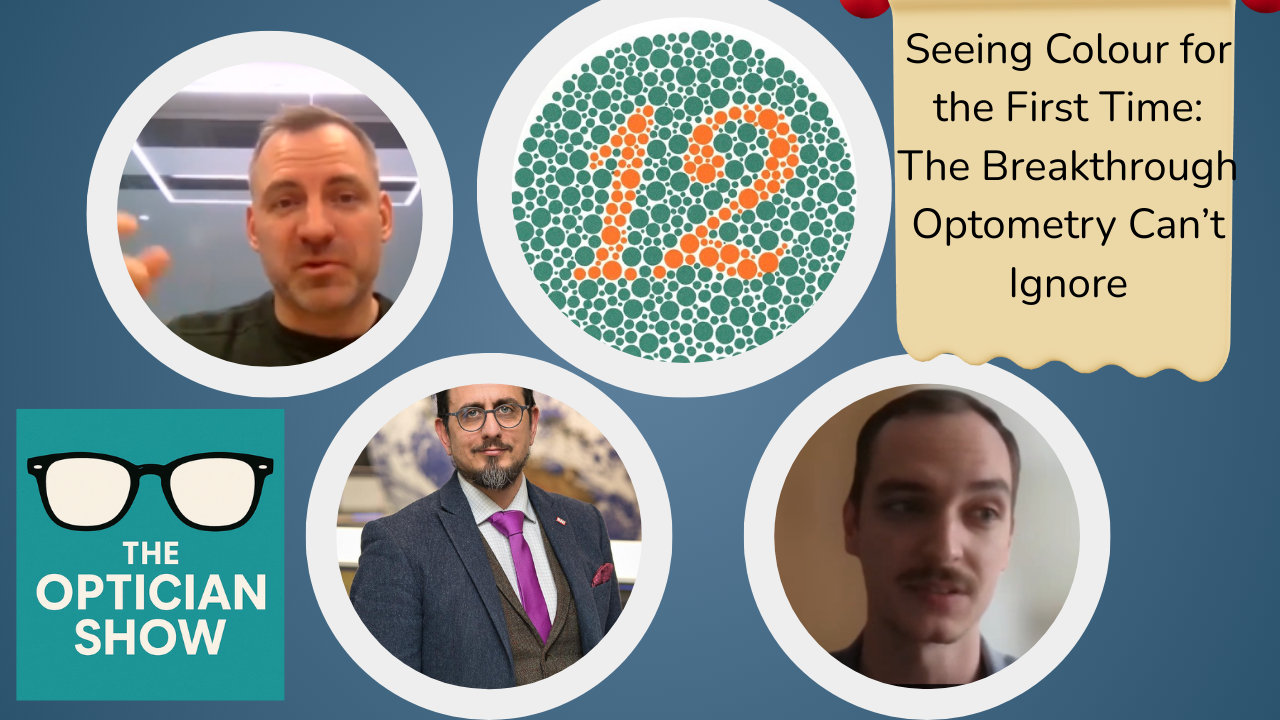
In this powerful first episode, Garry Kousoulou sits down with the innovators behind COLORON® Color Vision Tests — the revolutionary colour-vision technology transforming the lives of millions living with colour deficiency.
What begins with a remarkable story about Hungarian tomato puree in the 1980s unfolds into one of the most important optical breakthroughs of our time. Garry, Balázs and Máté reveal the science, the journey, and the emotional impact behind filters that allow colour-deficient patients to see colours they’ve never seen before.
From optometry practice owners to eye-care professionals and anyone touched by colour vision deficiency, this episode uncovers:
Why colourblindness is more common — and more hidden — than most realise
The emotional shame many patients feel, and why this solution changes everything
The scientific breakthrough behind COLORON’s lenses
Real reactions from patients seeing new colours for the first time
How the UK market is preparing for a colour-vision revolution
This is Part One of a story that will reshape optical practice, empower patients, and redefine what’s possible in eye care. If you’re a healthcare professional — or someone who cares about human impact — you won’t want to miss it