

I Was Diagnosed With ADHD and Autism at 52 — Here's What Nobody Tells You
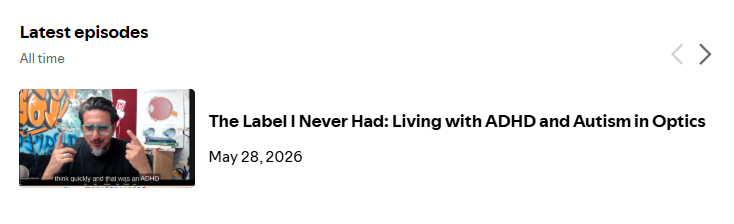
The podcast above is the first of a mini-series of my journey. I only got diagnosed today, so I’m still letting it sink in. You can listen live by clicking on the image above.
What Nobody Tells You Is That You Already Knew
There is something deeply unsettling about sitting in a room and being told, at 52 years old, that your brain has always worked differently. Not broken. Not less. Just different. And yet, despite the clinical language, despite the checklists and the assessments and the careful professional voice walking you through the findings, the strangest part is not the shock of it. The strangest part is the recognition.
Because somewhere inside, you already knew.
I never liked school. Not in the way that some children don’t like school because it’s boring or because they’d rather be outside. I didn’t like school because it felt wrong in a way I couldn’t articulate. The structure, the expectation that everyone learns at the same pace, in the same way, sitting still, following the thread — none of it made sense to a mind that was already leaping ahead, making connections nobody had asked for, getting distracted by something far more interesting than what was on the board. I wasn’t disruptive. I wasn’t a troublemaker. I just wasn’t quite there, even when I was.
And then came the dispensing course. If you work in optics, you’ll know that qualifying as a dispensing optician is no small thing. The level of precision required, the clinical knowledge, the sheer volume of detail you need to hold in your head and apply accurately under pressure — it demands a particular kind of focus. And focus, as I now understand, is complicated when you have ADHD. I struggled in ways I couldn’t explain to anyone around me, least of all myself. Other students seemed to absorb it naturally, to find a rhythm in the learning that I could never quite locate. I had to find my own way through, and I did — but the cost of that was a quiet, persistent sense that I was working twice as hard just to keep up with people for whom it seemed effortless.
That feeling followed me into the profession itself. Working alongside optometrists and other dispensing opticians, I often felt like an outsider at my own table. There is a particular culture in optics — measured, precise, often quite formal — and while I respected it enormously and built my career within it, I never quite moved through it the way others did. I was always a little more energetic, a little more instinctive, a little less interested in convention for its own sake. I made it work. In fact, I more than made it work — I built something remarkable over 36 years. But the feeling of being slightly out of step never really left.
What nobody tells you about a late diagnosis is that it doesn’t just explain today. It explains everything. It reaches back through your entire life and reframes moments you had long since filed under personal failure or character flaw. The difficulty concentrating. The restlessness. The sense of not quite fitting in, not just at school, not just in training, but in rooms, in conversations, in your own skin. All of that gets quietly reclassified. Not as weakness. As neurodiversity.
I also received a diagnosis of autism alongside the ADHD, which I genuinely did not see coming. The ADHD made a kind of instinctive sense — the energy, the quick thinking, the way my mind moves. But the autism gave me pause. And yet, when I sat with it, when I thought about the patterns and the sensitivities and the way I have always processed the world slightly differently from the people around me, that too felt like recognition rather than revelation.
I am sharing this because 52 years is too long to wait. If any part of this resonates with you — whether you work in optics or not, whether you have a diagnosis or simply a quiet suspicion — please don’t do what I did and file it away. Get help. Get answers. Because knowing, it turns out, is not the end of something. It is very much the beginning.
Take breaks between patients where you can. Short breaks to recharge make a real difference — they reduce overwhelm and help restore the focus that a busy clinical environment constantly demands. Even two minutes between appointments, stepping away from the frame board and simply breathing, resets your concentration more than you might think. Reed
Protect your mindset deliberately. Many neurodivergent professionals feel pressure to appear neurotypical and overcompensate, which can lead to burnout and negative impacts on mental health. Starting each day with an intention — deciding consciously that today you will lead with your strengths — is not motivational fluff. It is a genuine protection against that exhaustion. Optics & Photonics News
Move your body at lunchtime. Whether it is yoga, a walk around the block, or simply stretching, short movement breaks and mindfulness exercises help regulate focus and reduce stress in ways that no amount of willpower can replicate. Elumind Centres
Build mindfulness into your routine. Mindfulness and stress management can help neurodiverse professionals better regulate emotions and manage distractions — two things that a precision-led profession like optics places constant demand on. RethinkCare
Know your triggers. Recognising the situations that make your symptoms worse and having a strategy ready before they arise is one of the most practical things you can do. Noise, fluorescent lighting, back-to-back appointments with no breathing room — identify what drains you and advocate for small changes where you can. Drcognitivehealth
Going to the gym really helps me, and I know I’m impulsive, so count to 10! If someone or something is making you go crazy in your head, take a deep breath, do some breathing, and go back to it. Impulsiveness can be a strength, but sometimes a massive weakness. An ounce of discipline is worth a tonne of regret.
Optics needs people like us. We just need to look after ourselves well enough to stay in it.