

The invention of intraocular lenses and how that’s affected millions of human beings around the world, and how that happened to have something to do with me.
I’ve always believed that life is full of signs — small nudges from the universe reminding us that we’re on the right path. But what happened to me recently, in a hospital of all places, was beyond anything I could have imagined. It was a story of connection, coincidence, and clarity — the kind of experience that shakes you awake and makes you realise just how extraordinary the ordinary moments in life really
The son of
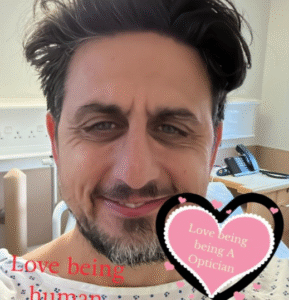
Waking Up to Connection
❤️Finding Purpose, Even Under Anaesthetic”
A few hours ago I had a minor operation, and as I came round from the anaesthetic, something amazing happened.
The first person I saw was the recovery nurse — I recognised that she was Nigerian, I asked her Igbo tribe? That might sound unusual to notice in such a moment, but connecting with people has always been second nature to me.
As I looked closer, I saw her push her glasses up her nose — they were too tight, not fitting properly. Even half-conscious, the optician in me couldn’t help but notice! I smiled and suggested she come see me in Room 150. Before I left, I adjusted her glasses, and we began a lovely conversation about her brother, who has cataracts.
It reminded me — I was born to be an optician mix that in with marketing knowledge, and a huge sense of purpose to connect with human beingsit’s really powerful.
I love helping people see better, but I also love where my journey in marketing has taken me: helping people connect.
⸻
Even Half-Asleep, I’m Still an Optician
Then, as I looked at her, I noticed something else — she kept pushing her glasses up her nose. It was the kind of subtle movement that most people would miss, but my optician brain went straight to work.
Her frames were too tight.
Now, bear in mind, I was barely conscious — still fighting off the effects of anaesthetic — but the optician in me never sleeps! I said to her, “Those glasses are too tight for your face. You should come and see me in Room 150 — I’ll sort them out for you.”
We both laughed, and before I left the hospital, I actually adjusted her glasses properly. That little act — that instinct to help — reminded me why I do what I do.
I wasn’t born just to sell glasses. I was born to help people see better — not just visually, but in life.
⸻
From Cataracts to Conversation
As we started chatting, she mentioned something personal: her brother had cataracts.
That’s when my professional curiosity kicked in. We talked about his treatment, about vision loss, and how life-changing modern surgery can be. It was one of those conversations that happens so naturally — one minute we’re strangers, and the next, we’re talking about family, health, and hope.
Even though I was there as a patient, that moment of human connection became the highlight of my day. It reminded me that purpose doesn’t pause — even when life forces you to slow down.
⸻
A Twist of Fate in the Lift
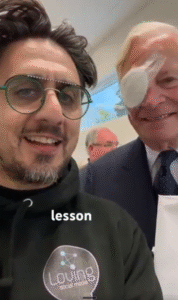
“Meeting the Son of the Man Who Revolutionised Eye Surgery – Sir Harold Ridley’s Legacy” 📄 Description: In this video, I share an unforgettable moment — I met the son of Sir Harold Ridley, the visionary who invented the first intraocular lens (IOL) for cataract surgery… in a lift!
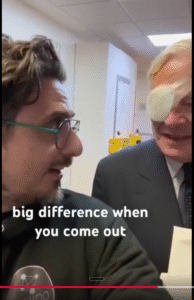
But that wasn’t the end of the story.
As I was leaving the hospital later that day, I stepped into the lift — still feeling a bit fragile but grateful. Standing next to me was another man, and we started chatting, as you do. He mentioned that he was there for his cataract surgery.
We kept talking, and then he said something that made me stop in my tracks.
He was the son of the inventor of intraocular lenses — the very lenses that are used in modern cataract surgeries all over the world.
I couldn’t believe it. What are the chances?
That morning, I’d been talking to a nurse about her brother with cataracts. Just hours later, I was standing next to the son of the man who revolutionised cataract treatment forever.
A one-in-a-trillion coincidence? Maybe. But I don’t think so.
I think the universe sometimes lines things up perfectly to remind you that you’re living your purpose.
The “Trillion to One” Probability To conceptualize a trillion to one, it helps to break down the required conditions. Even conservative estimates of the individual variables quickly multiply into the trillions. We have to multiply the independent probabilities of several events occurring simultaneously: the Probability of both men needing surgery at the same general time in their lives. (Low, but plausible over many years). Probability of both men choosing the same specific hospital out of hundreds of potential hospitals. (Low, perhaps 1 in 100). Probability of both surgeons scheduling them on the exact same day out of approximately 250 surgical days in a year. (Low, e.g., 1 in 250). Probability of their specific arrival/departure times overlapping in the same small area (the lift bank) within the short window of their stay. (Very low, perhaps 1 in 50). Probability of a random encounter in a specific lift at the exact moment their paths crossed. (Also very low). The Multiplier Effect
⸻
The Universe Has a Sense of Humour
Now, let’s add one more layer to this story.
The clothes I chose that morning — without any real thought — were my “Social Media Expert” hoodie and my “Choose Love” T-shirt.
It makes me smile when I think about it. There I was, wearing two statements that summed up my life: I help people connect through social media, and I believe in choosing love in every interaction.
Even lying in a hospital bed, half sedated, I was still living that message. I wasn’t thinking about algorithms or engagement rates — I was connecting with a nurse, seeing her for who she was, noticing her discomfort, and offering help.
That’s what “social” really means. It’s not about posts or platforms — it’s about people.
Listen to the whole story through this podcast.
In this extraordinary episode, Garry Kousoulou sits down with Nick Ridley of the Ridley Eye Foundation to uncover one of the most important — and least widely known — stories in modern medicine: the invention of the intraocular lens and how it transformed cataract surgery forever.
This is not just a conversation about eye care. It’s a story about courage, curiosity, rejection, and legacy.
Nick shares deeply personal memories of his father, Sir Harold Ridley — the British ophthalmic surgeon who, against fierce opposition from the medical establishment, performed the world’s first successful intraocular lens implant in 1949. At a time when the rule in ophthalmology was “never put anything in the eye — only take things out,” Ridley challenged centuries of belief and risked his entire career to restore sight to patients who would otherwise face inevitable blindness.
Remarkably, the invention was never patented. Sir Harold Ridley believed the lens should belong to humanity, not profit — a decision that has since allowed over one billion people worldwide to benefit from cataract surgery.
Nick recounts witnessing this historic operation as a six-year-old child, watching from an adjoining room as his father carried out the first surgery ever filmed in colour. He also describes the years of criticism and isolation his father endured before finally receiving global recognition late in life — including a standing ovation from thousands of ophthalmologists when he was in his nineties.
The episode then moves from history to the present day, exploring the ongoing work of the Ridley Eye Foundation. Founded in 1967, the charity continues Sir Harold’s mission by delivering life-changing cataract surgery to people living in some of the most remote and challenging environments on earth — particularly in the high-altitude regions of Nepal. These are communities where untreated cataracts mean total blindness, poverty, and isolation.
Nick explains how surgical teams trek for days into the Himalayas, converting schools and basic buildings into operating theatres, restoring sight using techniques adapted specifically for extreme conditions. In a single year, thousands of patients are examined and hundreds regain their vision — often seeing clearly for the first time in decades.
The conversation also reveals the extraordinary coincidence that brought Garry and Nick together: a chance meeting in a hospital lift, moments after Garry came out of surgery and Nick had undergone cataract treatment himself. What followed was a conversation that connected past, present, and future — clinician to patient, innovator’s son to modern optician, legacy to possibility.
This episode is a powerful reminder that innovation often begins with one person brave enough to challenge convention — and that true progress happens when compassion meets action.
If you care about healthcare, humanitarian work, medical innovation, or stories that genuinely restore faith in humanity, this is an episode you won’t foget
Modern-Day Medical Miracles (and Where This Ranks): • Vaccination programmes (polio, smallpox eradication) • Antibiotics and infection control • Organ transplantation • Medical imaging (MRI & CT scanning) • Anaesthesia and modern surgery • Insulin for diabetes • Antiretroviral therapy for HIV • Intraocular lens cataract surgery – consistently ranked among the top 5 medical breakthroughs of all time, restoring sight to over one billion people worldwide and continuing to change lives every single day.
Vision Beyond Sight
For me, being an optician isn’t just a job. It’s a calling. Every day, I get to help people see more clearly — not only through lenses, but through the way they look at the world.
And being in marketing, especially through Loving Social Media, gives me another way to serve. I help businesses tell their stories, connect with their communities, and find meaning in what they do.
Those two sides of my life — the optician and the communicator — are really one and the same. Both are about clarity. Both are about helping people see.
That day in the hospital, those two worlds collided in the most unexpected way.
⸻
A Lesson in Purpose
When I tell people this story, they often laugh at how unlikely it sounds. And yes, the odds of meeting the son of the inventor of intraocular lenses — on the same day I talked about cataracts with a nurse — are astronomical. But what I take away from it isn’t the coincidence itself.
It’s the message behind it.
Even when life slows you down — even when you’re the patient instead of the professional — your purpose doesn’t disappear. It’s written into who you are.
I didn’t plan to connect with anyone that day. I didn’t plan to teach or help or inspire. But somehow, those moments found me anyway.
That’s what passion does. It seeps into every corner of your life until it becomes part of your DNA.
⸻
Gratitude and Clarity
As I write this, I’m feeling nothing but gratitude. Grateful to the incredible medical staff who looked after me. Grateful for the nurse and our beautiful conversation. Grateful for that brief encounter in the lift that reminded me of the wonder of human connection.
Most of all, I’m grateful to be alive and to have a mission.
A mission to serve others.
To connect humans.
To make visual challenges not a challenge at all.
And to help people see — in every sense of the word.
⸻
Final Thoughts
Some might call it coincidence. I call it confirmation.
Confirmation that I’m doing exactly what I was born to do — helping people see clearly, helping them connect, helping them love what they see.
So, to everyone reading this — whether you’re in optics, marketing, or any other field — remember: your purpose doesn’t pause. It follows you everywhere, even into the operating theatre, even into the lift, even under anaesthetic.
And when you live with love, the universe finds ways to remind you — in the most beautiful, unexpected, one-in-a-trillion ways — that you’re exactly where you need to be.
⸻
By Garry Kousoulou
Founder, Optician & Social Media Expert
LovingSocialMedia.com