

What Brian Tompkins Knows About Loyalty
A child sits in the testing chair at Tompkins Knight & Son. They are young enough to still believe in Father Christmas, yet old enough to think the man opposite them is slightly unusual.
The optometrist leans forward and gently presses the tip of the child’s nose. The chair rises. The child gasps in surprise.
Then he softly tugs their ear. The chair lowers again.
The child bursts into laughter.
Across the room, a parent looks up from their phone and smiles. Brian keeps a Beta Pole chair in the consulting room for moments exactly like this. The parent isn’t smiling only because of their child’s reaction. They are smiling because they remember.
Thirty years earlier, they sat in the same room. The same optometrist pressed their nose and lifted them into the air too.
Half a century of practice is captured in that single moment.
A foot pedal sits hidden beneath the desk. Patients never see it. Yet that simple detail has helped create lasting memories for generations of families. Parents returned with their children. Those children grew up and returned with families of their own. Somewhere along the way, what could have been a routine clinical appointment became a story worth sharing.
As Brian explains:
“What happens now is the patient’s coming in with their children. I’m doing it to their child. And they are saying, you did that to me when I was little. So it’s just where do you stand on being professional and still having fun?”
The story reveals far more than a clever trick with a chair. It demonstrates how small moments can build trust, loyalty, and lasting relationships. Before the reader learns anything about Brian’s achievements or fifty years in practice, they already understand why generations of patients continue to return.
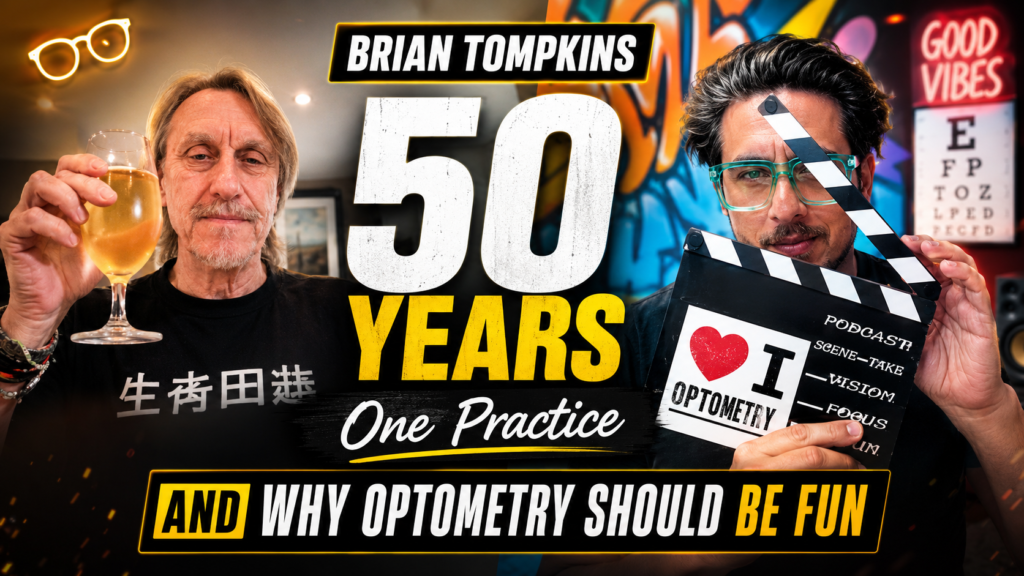
Fifty Years in One Practice
In just a few weeks from the date of our conversation, Brian Tompkins will celebrate a remarkable milestone. He will have spent fifty years working in the same practice.
Not fifty years in optics.
Fifty years in one practice.
Tompkins Knight & Son was established in 1868. Brian joined the practice in 1976 as a young optometrist and has remained there ever since. Today, he serves as co-director alongside a team he openly describes as “geniuses.”
That achievement says a great deal about both the man and the practice.
Patients do not stay loyal for decades when they feel like just another appointment in the diary. Talented team members do not remain for eighteen, twenty, or even twenty-five years unless they feel valued and respected. Likewise, professional organisations do not repeatedly invite someone to speak at conferences, join leadership teams, and contribute to industry discussions unless they have something worthwhile to say.
Brian has earned that respect throughout the profession.
He served as President of the British Contact Lens Association, holding the role for two years rather than the traditional one. As he explained on the podcast, “one year just turns around too quickly.”
His achievements extend well beyond optics. In 1993, he reached the final stages of MasterChef. The experience gave him the confidence to step onto a stage and speak publicly for the first time. It was a skill that would later serve him throughout his career.
Away from the profession, Brian is also a proud father. One son built a successful career as a chef, while the other became a graphic designer. Family, relationships, and creativity have always played an important role in his life.
Then there is the story that arrived just before the fiftieth-anniversary celebrations.
A few weeks before the milestone, Brian received a card in the post from his former pre-registration supervisor, Pat Bicknell. The card contained a memory from fifty years earlier.
Pat reflected on how different practice had been in those days. The diagnostic equipment available to them was remarkably simple. A sheet of cloth pinned to a wall. A stick used for visual field testing. A trial lens kit.
And that was it.
For someone celebrating fifty years in practice, the card was more than a message of congratulations. It was a reminder of just how far both the profession and the people within it had travelled.
What Comes Next ?
Brian is not afraid of the future. He has watched the profession move from a sheet of cloth on the wall to AI-driven fundus analysis, and he sees the next wave coming with the same curiosity he has brought to every previous one. Earlier this year, he was at a trade show in Munich and walked up to a fully automated AI refraction machine. He sat in the chair to see what it could do.
“I sat there and said, refract me. And it said, cover your left eye, and I deliberately covered my right. It said, you’ve covered the wrong one. So this robot’s pretty clever.”
There was a pause.
“But it’s never going to tell jokes. It’s never going to do magic. It’s never going to hold your hand if you’re worried because your husband’s just been diagnosed with something terrible.”
That, in two sentences, is Brian’s case for the future of independent optometry. Yes, the robots are coming. Yes, AI refraction will get extraordinary. But the part of the job that matters most — the part patients pay for, the part patients come back for — that part is human. And it will remain human for as long as humans are doing the worrying.
The other frontier that excites him is the eye as a window onto the rest of the body. Brian talks at length about the work being done by Dr Noon and the Heart Project, an AI-driven analysis that uses fundus photographs to estimate cardiovascular risk. Men, it turns out, are notoriously bad at attending GP appointments but will often attend an eye test. If the eye exam can flag heart disease risk, optometrists are suddenly in the business of saving lives in a way no one quite expected.
Higher order aberrations are the third. Brian says they have come up at every single one of the six conferences he has attended this year. Patients who used to live with 6/12 vision – ghosts, stars, terrible night driving – are being pulled down to 6/6 and sometimes beyond.
“Within the world of optometry,” he says, “there are so many capabilities to have fun. Never stop enjoying your wonderful career and passion.”
Lorem ipsum dolor sit amet, consectetur adipiscing elit. Ut elit tellus, luctus nec ullamcorper mattis, pulvinar dapibus leo.
About the Guest
Clinical Expertise
Brian Tompkins, FCOptom, is the co-director of Tompkins Knight & Son, an independent optician practice in Northampton that was established in 1868. Having joined the practice as a young optometrist in 1976, Brian is approaching an extraordinary milestone of nearly fifty years serving patients from the same location.
Over five decades, he has helped build one of the UK’s most respected independent optometry practices. His clinical expertise includes complex contact lens fitting, with a particular focus on keratoconus, post-graft corneas, irregular astigmatism, EyePrint Prosthetic lenses, and the wavefront-guided correction of higher-order aberrations. Tompkins Knight & Son was the first practice in the UK to offer the EyePrint Prosthetic and remains among a small number of clinics worldwide working at the forefront of bespoke scleral lens technology.
Brian is a Past President of the British Contact Lens Association and is widely recognised as one of the profession’s leading educators and speakers. Throughout his career, he has lectured nationally and internationally on contact lenses, advanced eye care, scleral lens fitting, higher-order aberrations, and the future of optometric practice. Recent appearances have included presentations at the World Congress on Keratoconus in Italy and multiple international conferences across Europe.
Beyond clinical practice, Brian is a 1993 MasterChef finalist, author of the children’s book Sunny Goes to the Optometrist, and a dedicated mentor to optometrists, dispensing opticians, and optical students around the world. His practice regularly welcomes visiting practitioners from across Europe, Australia, and beyond who come to learn from his experience and expertise.
Despite his reputation within the profession, Brian remains approachable and accessible. He still answers his own messages and continues to share his knowledge generously with colleagues, patients, and the wider optical community.
Find Brian on Facebook and Instagram, or visit Tompkins Knight & Son to learn more about his work and practice.
About the Host
Garry Kousoulou FBDO is a Fellow of the British Dispensing Opticians with more than thirty-six years of experience in the optical industry. He is the founder of Loving Social Media, a digital marketing agency that helps independent opticians and healthcare businesses attract more patients through effective online marketing and storytelling.
Alongside his marketing work, Garry is the owner of Good Looking Optics, the independent optical practice he built from the ground up in Enfield without an inherited patient base. He is also the UK and Ireland distributor for ColourOn, an innovative colour vision enhancement lens system designed to support people with colour vision deficiency—a cause that is particularly important to him as someone who lives with CVD himself.
Garry hosts The Optician Show, a podcast created for independent practice owners, optometrists, and dispensing opticians who want to grow their businesses while maintaining a strong patient-first approach. Through in-depth conversations with industry leaders, innovators, and practitioners, the show explores the future of independent optometry, business growth, leadership, and patient care.
His professional experience extends beyond practice ownership. Garry is a former board member of the Association of British Dispensing Opticians, a judge for the Business Book Awards, and the founder of the Enfield Business and Community Awards.
Today, his work combines clinical optics, digital marketing, and strategic storytelling. He has helped independent optical practices across the UK improve patient acquisition, strengthen their online presence, and communicate their value more effectively. Outside work, he is a cricket umpire, an active member of the Enfield community, and a passionate advocate for supporting the next generation of optical professionals.
Subscribe to The Optician Show wherever you listen to podcasts, or connect with Garry on LinkedIn and Instagram to continue the conversation.
About the Host
Garry Kousoulou, FBDO, is a Fellow of the British Dispensing Opticians with more than thirty-six years of experience in the optical industry. He is the founder of Loving Social Media, a digital marketing agency that helps independent opticians and healthcare businesses attract more patients through effective online marketing and storytelling.
Alongside his marketing work, Garry is the owner of Good Looking Optics, the independent optical practice he built from the ground up in Enfield without an inherited patient base. He is also the UK and Ireland distributor for ColourOn, an innovative colour vision enhancement lens system designed to support people with colour vision deficiency—a cause that is particularly important to him as someone who lives with CVD himself.
Garry hosts The Optician Show, a podcast created for independent practice owners, optometrists, and dispensing opticians who want to grow their businesses while maintaining a strong patient-first approach. Through in-depth conversations with industry leaders, innovators, and practitioners, the show explores the future of independent optometry, business growth, leadership, and patient care.
His professional experience extends beyond practice ownership. Garry is a former board member of the Association of British Dispensing Opticians, a judge for the Business Book Awards, and the founder of the Enfield Business and Community Awards.
Today, his work combines clinical optics, digital marketing, and strategic storytelling. He has helped independent optical practices across the UK improve patient acquisition, strengthen their online presence, and communicate their value more effectively. Outside work, he is a cricket umpire, an active member of the Enfield community, and a passionate advocate for supporting the next generation of optical professionals.
Subscribe to The Optician Show wherever you listen to podcasts, or connect with Garry on LinkedIn and Instagram to continue the conversation
Brian Tompkins: 50 Years, One Practice, and Why Optometry Should Be Fun
Brian Tompkins is one of the finest optometrists and practitioners I have ever had the pleasure of knowing. More importantly, I am fortunate enough to call him a friend.
This episode of The Optician Show is about far more than reaching an incredible milestone of fifty years in practice. It is a conversation about the stories, relationships, humour, values, and experiences that have made Brian one of the most respected figures in independent optometry.
Throughout our discussion, we explore the moments that patients remember long after they leave the consulting room. We talk about children sitting in the chair for the first time, parents recalling the very same experience decades earlier, and the importance of creating an environment where patients feel comfortable, valued, and genuinely cared for.
Brian believes that great patient care should never come at the expense of personality. In fact, he argues the opposite. Some of the strongest patient relationships are built through warmth, humour, and human connection.
His voice runs through every part of this conversation.
From “If you’re not having fun, what is the point?” to “Surrounding yourself with smarter people is a good move,” Brian shares lessons learned from five decades of serving patients, leading teams, mentoring colleagues, and helping shape the future of the profession.
We also discuss some of the biggest topics facing optometry today. The conversation covers artificial intelligence, advances in contact lenses, the future of the eye examination, the role of the NHS, patient-centred care, and the opportunities technology creates for practitioners willing to embrace change.
At the heart of it all is a simple philosophy. Every patient should be treated with the same care, respect, and attention you would give to a member of your own family.
The closing message captures Brian’s mindset perfectly:
“Never be afraid. Always follow something which you are slightly afraid of, and get to grips with it.”
It is advice that has guided his career and continues to inspire those around him.
This was a brilliant conversation with a brilliant man. It was also a reminder of what makes independent optometry so special.
Brian Tompkins’ career demonstrates the qualities we always encourage independent practices to showcase online: personality, trust, expertise, community involvement, patient care, humour, and a genuine passion for helping people.
For opticians, social media should be about much more than selling glasses or promoting offers. The most effective content tells the story behind the practice. It highlights the people, the conversations, the expertise, and the experiences that make a business unique.
Patients do not return year after year because of a discount. They return because of relationships, trust, consistency, and the way a practice makes them feel.
That is the real lesson from Brian’s fifty years in practice.
When optometry is delivered with care, personality, expertise, and purpose, it deserves to be seen, shared, and celebrated.
Add Your Heading Text Here
Lorem ipsum dolor sit amet, consectetur adipiscing elit. Ut elit tellus, luctus nec ullamcorper mattis, pulvinar dapibus leo.