

Color vision deficiency never needs to hold you back
See The World Differently — Together
Colour Vision Deficiency Day is here, and it's bringing something new: a whole community, meeting online, in one place, at one time. If you've ever quietly worked around a colour you couldn't quite place — this one's for you.
Colour vision deficiency (CVD), often called colour blindness, touches around 1 in 12 men and 1 in 200 women — roughly three million people across Britain. Most people with CVD don't see in black and white at all. They see colour, just not quite the way everyone else does — and loads of them have spent years quietly working around it without anyone noticing.
"People can become so skilled at compensating that even their families, teachers and colleagues never realise they experience colour differently."
Garry Kousoulou FBDO, dispensing optician and colour-vision campaigner
This online check is for initial screening and awareness only — it doesn't replace a professional eye exam. If you're concerned about your own or your child's vision, book in with a qualified eye-care professional.
The Community Call: Everyone's Invited
🕓 Sunday 6 September, 4:00pm (BST)
This is the big one. An international video call bringing together anyone and everyone with colour vision deficiency — one screen, loads of time zones, one shared experience. Come and talk about the challenges, swap the clever little tricks you've picked up over the years, and hear how other people crack the same problems. No judgement, no expertise required — just a safe space to be honest about how you see the world.
What actually is colour vision deficiency?
It means seeing colours differently from most people, and finding certain ones tricky to tell apart. The most common inherited types muddle up reds and greens, though other types exist too. CVD can run in families, or it can develop later because of an eye condition, another health condition, an injury, or certain medicines.
The NHS guidance on colour vision deficiency is clear: inherited CVD doesn't currently have a cure. But most people adapt brilliantly, and some find that practical adjustments or specialist colour-enhancing aids help them tell colours apart. What those aids can't do — and shouldn't ever claim to do — is restore normal colour vision or cure inherited CVD.
The quiet art of masking it
Loads of colour-deficient people build coping strategies so naturally they don't even clock it as "masking." They learn the rules, the positions, the context clues — instead of the colour itself. It's genuinely impressive problem-solving. It's also exactly why the condition stays hidden.
- Memorising which position a traffic light is in, rather than trusting the colour.
- Reading the label before picking clothing, paint, or wiring.
- Watching which pencil, chart, or indicator someone else reaches for first.
- Smelling or touching food to check it's ripe, or cooked.
- Quietly dodging colour-based tasks, or double-checking with someone else.
- Figuring out the "expected" answer without ever explaining why.
None of this is a lack of intelligence, care, or effort — quite the opposite. It's resourcefulness. But nobody should have to hide a genuine visual difference just to avoid an awkward moment.
Women get overlooked too
Inherited red-green CVD shows up far less often in women than in men — and that statistic can become its own barrier. A woman or girl who says colours are tricky may get brushed off, simply because CVD is still seen as a "male thing."
There isn't solid evidence that most women with CVD are masking it. What we can say is that women can be overlooked, diagnosed later, or have their experience dismissed purely because it's less expected. Listening to the individual beats leaning on the stereotype, every time.
Could it be affecting a child at school?
Colour is everywhere in a classroom — maps, graphs, science kit, art supplies, PE equipment, behaviour charts, screens, marked work. If the meaning only lives in the colour, a child with undiagnosed CVD can miss something their classmates spot instantly.
Signs worth watching for
- Unexpected colour choices in drawings.
- Struggling to sort things by colour.
- Getting muddled by maps, graphs, or colour-coded instructions.
- Hesitating or avoiding colour-based tasks.
- Leaning on classmates for what should be a simple choice.
Small changes that make a big difference
- Pair colours with words, symbols, or patterns.
- Use strong contrast and clear labelling.
- Name colours out loud when giving instructions.
- Never mark meaning with red and green alone.
- Run digital materials through a CVD simulator before sharing them.
Garry's offering free colour-vision awareness screening visits to schools in Enfield — not to label kids, but to start a helpful conversation early, alongside proper professional assessment.
A tailor who never made a fuss
For Garry, this whole campaign started at home. His Greek-Cypriot grandfather was colour deficient and spent his life as a tailor — a job built entirely on fabric, shade, and colour matching. He found his own way through it, without ever making his difficulty the headline.
That's exactly why CVD stays invisible so often. Someone can compensate so well that everyone around them assumes there's nothing going on. Garry's not out to make colour-deficient people look less capable — quite the opposite. He wants them to get proper understanding, accurate testing, and real choices.
Nearly a century of colour testing, in one museum
Garry's been invited to contribute colour-vision testing material to the British Optical Association Museum at the College of Optometrists — kit that shows how practitioners have examined sight and colour perception across generations, some of it nearly 100 years old.
Which raises a genuinely modern question: if we've been testing colour vision for almost a century, why are so many people still reaching adulthood without ever understanding their own experience?
Next stop: London's New Year's Day Parade
This isn't a one-day thing. There are plans in motion to bring colour-vision awareness to London's New Year's Day Parade — one of the most colourful spectacles in the capital, watched by a crowd who might never stop to think that not everyone sees it the same way.
It's the perfect contrast: a celebration built on colour, in front of a public who mostly take their own colour vision for granted. Want to get involved, share your story, or back the campaign? Get in touch with Garry.
Why don't we talk about this more?
CVD is common, but it's usually painless and invisible. People quietly adapt instead of seeking help, and the topic falls between eye health, education, accessibility, workplace safety, and design — nobody's sole responsibility, so it gets less airtime than it deserves.
Colour Vision Deficiency Day is the moment to change that. Parents can ask better questions. Teachers can stop leaning on colour alone. Employers can audit their dashboards and instructions. Designers can pair colour with labels and symbols. And people with CVD can finally talk about their experience without a shred of shame.
Three ways to get involved today
- Take the free colour-vision check — it takes two minutes.
- Join the global community call, Sunday 4pm — jump in here and meet people who get it.
- Share this using #ColourVisionDeficiency and #ColourBlindAwareness — someone in your feed needs to see it.
Remember: screen settings, lighting, and device quality can all affect an online check — it's a starting point, not a diagnosis.
Quick answers
Is colour vision deficiency the same as seeing in black and white?
No. Seeing no colour at all is genuinely rare. Most people with CVD see colour just fine — certain shades are just hard to tell apart.
Can women have colour vision deficiency?
Yes. Inherited red-green CVD is less common in women, but it absolutely happens — and their experience shouldn't be dismissed just because it's statistically rarer.
Does a normal eye test include colour-vision testing?
Not automatically. It's not part of a routine NHS eye test — but you can always ask your optician for one if something feels off.
Can an online test diagnose CVD?
No — think of it as a first clue, not a diagnosis. Screen brightness and calibration can skew the result, so a professional assessment is what actually confirms it.
Is there a cure?
Not currently, for the inherited kind. Adjustments and specialist colour-enhancing aids can help some people tell colours apart — they don't restore "normal" colour vision, and no honest product will claim otherwise.

From Hungarian Tomato Purée to a Colour Vision Revolution
The story behind COLORON®
Some origin stories start in a lab. This one starts with a jar of tomato purée in 1980s Hungary — and somehow ends up rewriting what's possible for millions of people with colour vision deficiency. That's the kind of episode this is.
In this first episode, Garry Kousoulou sits down with Balázs and Máté, the innovators behind COLORON® colour vision tests — the filter lens technology helping opticians support patients with colour vision deficiency across the UK. What starts as an unlikely story about tomato purée unfolds into one of the more overlooked breakthroughs in modern optics: how a chance discovery decades ago led to lenses designed to help colour-deficient wearers tell colours apart more easily in everyday life.
Garry, Balázs and Máté get into the science, the journey, and the human side of it all — including the moments when patients try the filters and describe, in their own words, distinguishing shades they'd always struggled with.
Whether you're an optometry practice owner, an eye-care professional, or someone personally touched by colour vision deficiency, this episode covers:
- Why colour blindness is more common — and more hidden — than most people realise
- The quiet shame many patients carry, and why open conversation changes that
- The science behind COLORON's filter lenses, in plain English
- How some patients describe their experience the first time they try the filters
- How the UK optical market is starting to respond to colour vision support technology
This is Part One of a story that's shaping up to influence optical practice for years to come. If you're a healthcare professional — or you just care about the human impact behind the science — this one's worth your time.
The Weight of Masking: What Silence Costs
A hidden condition, carried quietly for generations
My grandfather spent his whole working life as a tailor, surrounded by exactly the thing his eyes struggled with most: colour. Before he ever picked up a spool of thread, he'd quietly check with my grandmother which one it actually was — never in front of a customer, never in front of the other tailors. He kept it that way his entire life. I never once heard him call it colour vision deficiency. I don't think he had the word for it at all.
It turns out that's not unusual. It's the pattern.
"He worked with colour throughout his life, yet he was colour deficient. Like many people, he found ways to compensate and carry on."
Garry Kousoulou, speaking to the Enfield Dispatch
It's rarely spoken about — but it's everywhere online
Search the trade forums and support communities where colour-deficient people actually talk about their day-to-day lives, and the same quiet pattern shows up again and again — usually written by people who've never told this to anyone in person.
On an electricians' forum, one tradesperson explained the techniques they'd built up over years of commercial wiring work, then added, almost as an afterthought:
"I haven't told anyone that I'm colourblind in my local [union branch]."
Anonymous electrician, industry trade forum
Others describe being misread entirely — mistaken for careless, or lazy, or simply not paying attention, long before anyone realised colour was the actual issue. One person recalled that before their colour vision deficiency was known, a parent assumed they were being idle at a simple task, rather than genuinely unable to see what was being asked of them. It's a small story, but it repeats itself in classrooms, kitchens, and workshops everywhere: the behaviour gets judged long before the cause gets understood.
This isn't just anecdotal
Researchers have started using a specific term for this: CVD as an "invisible impairment" — a condition real enough to shape someone's whole working life, yet invisible enough that colleagues, teachers and even family members can miss it for years. Campaigners working directly with UK schools have gone further, warning that children with undiagnosed colour vision deficiency can be genuinely shut out of parts of their own education:
"Children with this SEND are being excluded from fully accessing education."
UK colour vision deficiency campaigner, evidence submitted on inclusive education
None of this is really about colour. It's about what happens when a genuine difference goes unspoken for so long that hiding it becomes the norm — for a child taught to guess the "right" answer instead of asking a question, for a tradesperson quietly building workarounds rather than raising a hand, for a tailor who never told a soul.
That's exactly why Colour Vision Deficiency Day exists, and why Sunday's global call matters as much as any lens or test ever could: it's one of the only spaces built specifically for people to stop compensating for an hour, and just talk about it.
Colour vision deficiency is common. So why are we still missing it?
Colour affects education, work, safety and everyday life. Yet colour vision deficiency can still go unnoticed for years, even after routine eye examinations.
Boys are commonly affected
Colour vision deficiency is particularly common in males, which makes early awareness especially important.
In a typical classroom
Statistically, a mixed classroom of around 30 pupils may contain a child with colour vision deficiency.
Years of Ishihara testing
The Ishihara test remains a fast and useful screening tool, but it must be carried out correctly and followed up where needed.
A condition that can hide in plain sight
During our conversation, one parent described how her son's colour vision deficiency was not identified at school or during earlier eye examinations. It was only when he struggled to distinguish between coloured pens at the age of seven that the issue became clear.
That story matters because colour vision deficiency does not always announce itself dramatically. Children can learn, adapt and remember colour labels so effectively that parents, teachers and even eye-care professionals may not immediately realise there is a problem.
“Never use colour alone to convey information.”
This was one of the clearest messages from the discussion. Colour can remain a powerful communication tool, but important information should also be supported with labels, numbers, symbols, patterns or shapes.
For parents
If you suspect your child sees colour differently, ask specifically for their colour vision to be tested rather than assuming it is automatically included in every eye examination.
For teachers
Be careful with worksheets, graphs, maps and classroom activities where colour alone communicates the answer or instruction.
For optical professionals
Ishihara testing is a screening test. Lighting, viewing distance, angle and the condition of the test plates can all matter.
For workplaces
Accessible colour is also a safety issue. Warning systems, high-visibility clothing and colour-coded instructions should never rely on colour alone.
Screening is only the beginning
The experts in the discussion stressed that Ishihara plates are useful because they are quick and practical, but they are still screening tools. Further testing may be required to understand the specific type and severity of someone's colour vision deficiency.
They also highlighted an important distinction around colour-enhancing filters. Filters may change the appearance of colours or help certain colours become easier to distinguish, but that is not the same as curing an underlying genetic colour vision deficiency.
Awareness can change someone's experience of the world.
Better testing, better education and more accessible communication can make a meaningful difference for children and adults living with colour vision deficiency.
Learn More About Colour Vision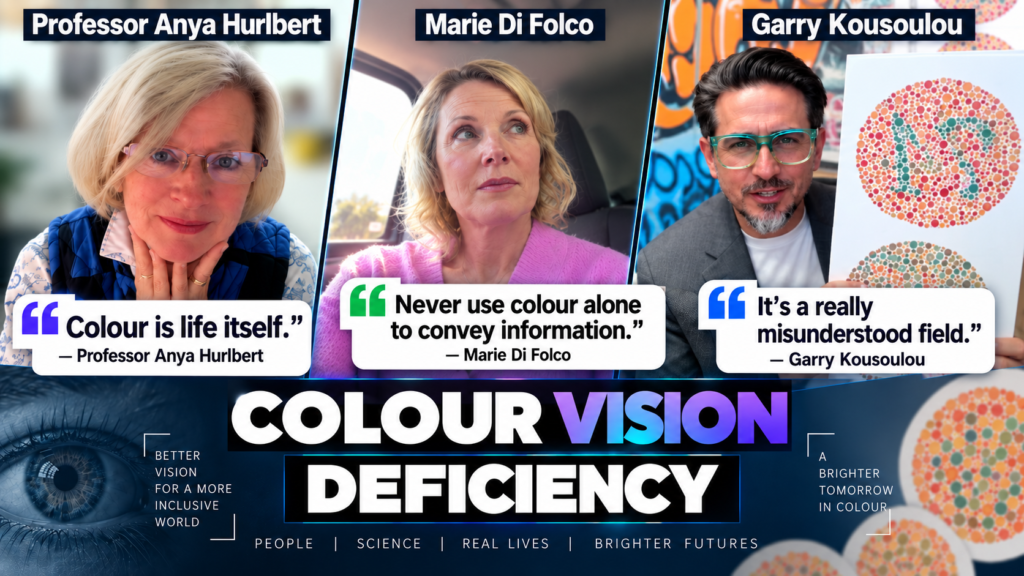

Colour vision deficiency is far more complex than simply being “colour blind”.
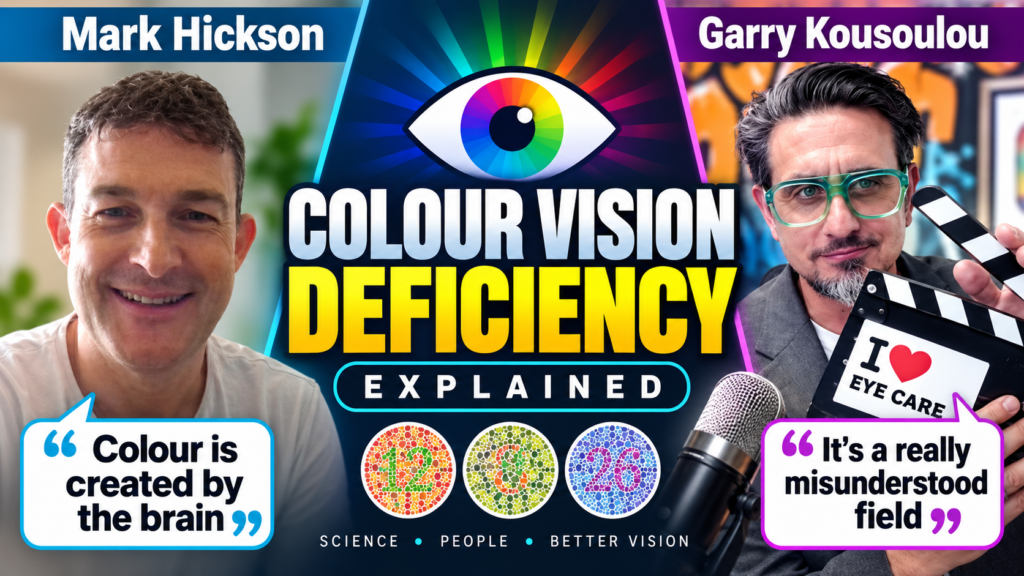
In this special episode, recorded around Colour Vision Deficiency Awareness Day, Garry Kousoulou is joined by Mark Hickson, Programme Leader for face-to-face teaching at Bradford College and lecturer in ophthalmic dispensing and visual optics.
Mark is a qualified dispensing optician with a specialist interest in visual perception, and this conversation explores what colour vision really is, how the brain interprets colour, why colour vision deficiency occurs, and why the optical profession may need to give the subject far more attention.
One of the most fascinating ideas discussed is that colour itself is not a physical property in the way most of us imagine. Light has different wavelengths, but the colours we experience are constructed by the brain. Mark explains how cone cells, rod cells and higher visual processing all contribute to the way we perceive the world around us.
The episode also looks closely at colour vision deficiency and the genetics behind it. Mark explains why congenital colour vision deficiency is far more common in men, how the X chromosome is involved and why a child with colour vision deficiency may have absolutely no idea that they see the world differently from everybody else.
That creates an important challenge for parents, teachers, opticians and schools.
A child may not complain that something is wrong because, to them, their vision has always been normal. Instead, clues may appear through behaviour at school, difficulties with colour-coded learning materials or problems distinguishing certain colours.
Garry and Mark also discuss the Ishihara colour vision test, one of the most recognisable tests used in eye care. They look at the different types of Ishihara plates, how the test should be used, why lighting and presentation matter and why old or faded testing books may not give reliable results.
This leads to a bigger question for the optical profession: are we testing colour vision often enough?
The conversation explores whether dispensing opticians and optical assistants could play a greater role in colour vision screening and whether practices should routinely have access to recognised colour vision tests.
The discussion then moves into careers.
For some occupations, accurate colour discrimination can be important for safety or professional requirements. The episode considers careers such as train driving, aviation, the military, electrical work and even highly specialised jobs such as producing prosthetic eyes.
However, colour vision deficiency should not simply be viewed as a limitation.
Mark shares the remarkable historical example of people with colour vision deficiency sometimes being able to detect camouflage more effectively because they are less distracted by certain colour patterns.
The episode also touches on one of the most famous examples of visual perception: the blue-and-black or white-and-gold dress illusion. Different people can look at exactly the same image and genuinely perceive different colours, demonstrating just how much colour perception depends on the brain rather than simply the eye.
This is a fascinating conversation for dispensing opticians, optometrists, optical assistants, students, parents, teachers and anyone interested in how human vision works.
Topics covered include:
Colour vision deficiency and colour blindness
How the brain creates our perception of colour
Cone cells and rod cells
The genetics of colour vision deficiency
Why colour vision deficiency is more common in men
The Ishihara colour vision test
Colour vision testing in opticians
Colour vision deficiency in children
Colour vision and schools
Careers affected by colour vision requirements
Dispensing opticians and colour vision screening
Visual perception and optical science
The blue-black / white-gold dress illusion
Awareness of colour vision deficiency
If you work in optometry, ophthalmic dispensing or eye care, this episode may encourage you to think differently about how often colour vision is discussed and tested in practice.
And if you are a parent, teacher or someone living with colour vision deficiency, it is a reminder that seeing colour differently does not necessarily mean seeing the world less clearly. It simply means the brain may be interpreting that world in a different way.
Featuring:
Garry Kousoulou – Dispensing Optician and host of The Optician Show
Mark Hickson – Programme Leader and Lecturer in Ophthalmic Dispensing and Visual Optics at Bradford College
Mark’s specialist area includes visual perception, of which colour vision forms an important part.
The episode also discusses why children with congenital colour vision deficiency may not realise that their vision differs from other people and why screening at school and in optical practice can be important.
If this conversation helps you understand colour vision deficiency a little better, please share it with an optician, parent, teacher or colleague who may find it useful.
Colour Vision Deficiency Awareness Day is an opportunity to start more conversations about a condition that affects the way millions of people experience colour every day.