
How do you get creative if you want to promote your dry eye clinic?
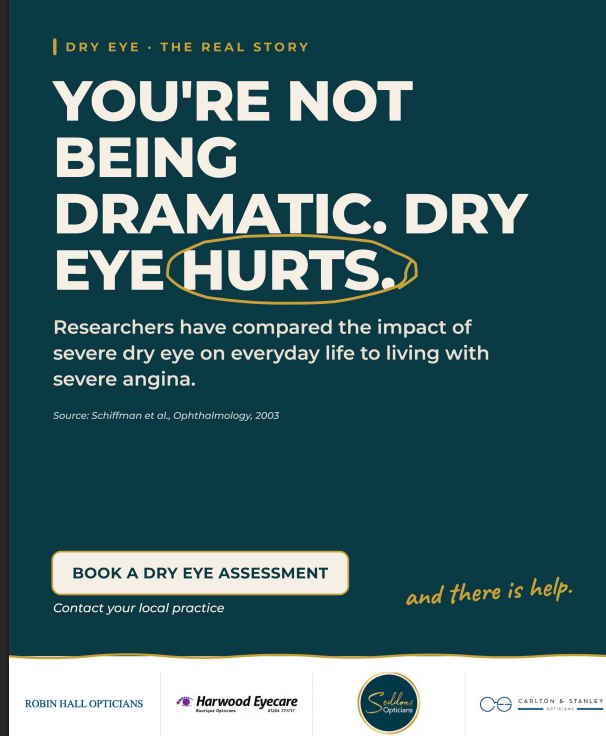
You love treating dry eye.
So why is the diary so quiet?
You've invested in the kit. You've done the training. You know you can change someone's day, every day. But the patients aren't coming through the door, and when they do, nobody's quite sure where they came from or whether they came back.
- Not enough dry eye enquiries
- No idea which marketing is working
- Patients drop off after treatment one
- The team isn't talking about it
There's no single golden bullet. There are about ten small ones, all fired together.
The patients are already out there
Most of the people you could help aren't searching for "dry eye clinic". They're buying another bottle of drops, rubbing their eyes at their desks and lying awake with burning eyes, thinking it's just their age. The opportunity is huge, and the job of your marketing is to reach those people before they give up.
Ten ways to market dry eye, working together
Here's how we'd build it for a practice. Each piece feeds the next, so a social post leads to a quiz, the quiz leads to a booking, and the booking becomes a patient who brings a friend.
A dedicated landing page
One page, one job: book a dry eye assessment. Written in your patients' words ("gritty", "like sand", "stuck shut in the morning"), with real faces from your team, what happens at the appointment, and the price.
Its own subdomain
Something like dryeye.yourpractice.co.uk. It's easy to say on the radio, print on a poster or put on a QR code, and it gives you clean, separate tracking from the rest of your site.
A symptom questionnaire
A short online "Do I have dry eye?" quiz, built on an established questionnaire such as OSDI or SPEED that your clinicians already trust. People get a score, you get a warm lead with their symptoms already written down.
Social posts that feel human
Myths and facts, "a day with dry eye", quizzes that ask for A, B or C in the comments, menopause, winter heating, screens and contact lenses. Thirty variations, one clear call to action: book a dry eye assessment.
Competitions
Seasonal ones work well: "Winter eye comfort kit" in November, "Screen survival pack" in January. Ask people to answer a question or comment, and follow Meta's promotion rules, which don't let you make sharing or tagging friends a condition of entry.
In-practice posters and screens
Posters with a QR code that goes straight to your landing page, plus a tick-list of symptoms at reception. People waiting for an eye test are the warmest audience you'll ever have.
Email and SMS to your existing patients
Your database already holds hundreds of people with gritty eyes. A short, story-led email in winter, another for screen workers, another for menopause. Segment it, don't blast it.
Tracking that actually tracks
A unique link for every campaign, a pipeline that shows each patient's stage, and a weekly number the whole team can see. More on that below.
The first-treatment goodie bag
A small, thoughtful thank-you at the end of treatment one turns a patient into a fan. That's when they're most likely to talk about you.
Birds of a feather
People with dry eye know other people with dry eye: their colleague at the next screen, their friend going through menopause, their book club. Give them an easy, generous way to bring that person in.
Posts that stop the scroll
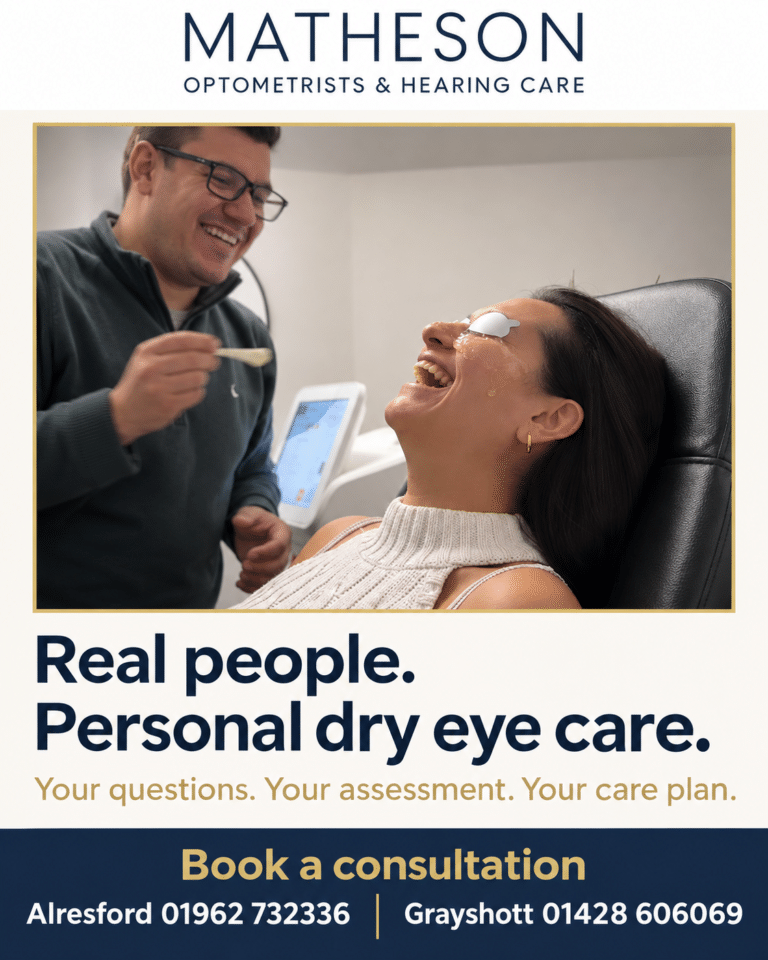
These come from a 30-post dry eye campaign we've been running for independent practices. They work because they don't sound like adverts. They sound like someone who understands.
You can't grow what you can't see
This is where most practices lose patients. An enquiry comes in on Facebook, someone writes it on a sticky note, and three weeks later nobody knows whether they booked. Here's the patient journey we set up, with a stage for every step:
- Enquiry: from a post, the quiz, a poster QR code or a friend's referral card. We capture the name, number and source every time.
- Assessment booked: an automatic text confirms the appointment and sends a short symptom questionnaire to fill in before they arrive.
- Assessment done: a treatment plan agreed. If they're not ready, we treat it as "not right now", not "no", and set a follow-up date.
- Treatment one: the goodie bag and the refer-a-friend card go home with them.
- Treatments two to four: for OptiLight, the manufacturer's recommended course is four sessions, two weeks apart, so every appointment is booked before they leave and reminders go out automatically.
- Review and maintenance: a review date in the diary, and a "how are your eyes?" message a few months later.
If you use OptiLight, the system keeps its own patient database with each patient's treatment history and can produce and email treatment reports. Use that for the clinical record, and match it up with your CRM so your marketing numbers and your clinical numbers tell the same story.
| What to measure each week | Why it matters |
|---|---|
| New dry eye enquiries, by source | Shows you which posts, pages and posters are working |
| Enquiry to assessment booked | Tells you how well the phone and the front desk are converting |
| Assessment to treatment | Shows whether the clinical conversation is landing |
| Patients completing all four sessions | Completion drives results, and results drive referrals |
| Referral cards redeemed | Your "birds of a feather" number |
Make treatment one feel like a gift
The end of the first treatment is an emotional moment. They've finally done something about it, and the goodie bag tells them they made the right call. Keep it practical and beautiful, and keep claims out of it: everything in the bag should be something your clinicians are happy to recommend.
- A branded tote or pouch they'll keep using, so your name goes out with them
- A reusable heated eye mask, with your clinician's instructions on how often to use it
- Lid hygiene essentials, such as lid wipes or a lid cleanser your team recommends
- A preservative-free lubricant sample, if it's part of their plan
- A "blink properly" desk card with the 20-20-20 screen-break reminder
- A treatment calendar showing sessions two to four, already filled in
- A cosy extra: a silk sleep mask, a herbal tea or a lip balm, because comfort is the whole point
- A handwritten thank-you card signed by the clinician and the team. This is the item people remember
Birds of a feather flock together
Tuck a refer-a-friend card into every bag: "Know someone who's always rubbing their eyes? Give them this card. When they come in for their dry eye assessment, we'll give them an M&S voucher to say welcome."
It works because the person with dry eye knows exactly who else is suffering. Keep the voucher modest, give it for booking an assessment rather than for buying treatment, and check the wording against the GOC standards and the ASA's CAP Code before you print.
None of this works unless the whole team is in
The best campaign in the world falls flat if the phone is answered with "we don't really do that". Dry eye has to be something the whole practice is proud of, from the front desk to the testing room.
Name a dry eye champion
One person who owns the pipeline, chases follow-ups and shares the weekly numbers. Some practices call it a dry eye coordinator.
Screen everyone
A quick symptom tick-list at check-in, and a question in every eye test: "Do your eyes ever feel gritty or tired?" That's how you find the patients you already have.
Script the phone call
Ask about symptoms before price, always take a name and number, and role-play it until it feels natural. One US practice reported its treatment conversion rising from about 30% to 67–75% after building this kind of team process.
Let the team try it
Team members who've had an assessment, or who have dry eye themselves, talk about it with real warmth. "Ask me about dry eye" badges start conversations without any selling.
Celebrate the wins
Share the thank-you messages and the referral cards that come back in your morning huddle. People get behind what they can see making a difference.
Put faces on it
Use real photos of your clinicians on the landing page and in your posts. Patients want to know who's looking after their eyes.
Ready to fill the dry eye diary?
I've spent 32 years in optics, built a practice from no patients to over £1 million in turnover, and I was the first optician in the world to use Facebook for business. At Loving Social Media we build the whole dry eye plan for you: the landing page and subdomain, the quiz, 30 posts, the tracking pipeline, the goodie bag and referral cards, and the team training that ties it together.
Call Garry: 07958 510183Garry Kousoulou FBDO, Managing Director, Loving Social Media
- Vidal-Rohr M. et al. The epidemiology of dry eye disease in the UK: The Aston dry eye study. Contact Lens and Anterior Eye, 2023.
- Lemp M.A. et al. Distribution of aqueous-deficient and evaporative dry eye in a clinic-based patient cohort. Cornea, 2012.
- Schiffman R.M. et al. Utility assessment among patients with dry eye disease. Ophthalmology, 2003.
- Specsavers menopause survey, reported in Optometry Today, July 2026.
- Nielsen, Global Trust in Advertising.
- Lumenis OptiLight Operator's Manual, UM-0005500DIG Rev F, Clinical Guide: Dry Eye Disease due to MGD.
- "Lumenis summit offers strategies for building and marketing specialty services", Optometric Management, Sept/Oct 2026.
Garry Kousoulou FBDO
Qualified dispensing optician and Managing Director, Loving Social Media
Garry isn't a marketer who learned about optics. He's an optician who became very good at marketing. He's spent 32 years in optics and qualified as a dispensing optician, and he knows dry eye from the consulting room as well as the marketing side: the patient who's tried every drop on the shelf, the assessment, the treatment options and the follow-up that keeps people comfortable.
He built his own practice, Good Looking Optics in Enfield, from no patients to more than £1 million in turnover. That's what led him to start Loving Social Media, which now looks after opticians all over the country and helps them fill their diaries with the patients they most want to help.
- First optician in the world to use Facebook for business, in 2007 (featured in a Meta case study)
- Wrote the first book on social media for opticians
- Has opened and sold three optical practices
- Former ABDO board member and helped create 100% Optical
- Has spoken at every 100% Optical
- First dispensing optician on the front cover of Optometry Today
- Host of The Optician Show, the optical business and marketing podcast