THE OPTICIAN SHOW / INDEPENDENT OPTICS
Vera Wang eyewear for UK opticians:
great frames deserve great marketing.
Considering the Vera Wang range? A practical stockist guide to the collection, the questions to ask Atlantic Optical and the launch that gives your patients a reason to look again.
Explore the stockist opportunity
A new frame collection should earn its place in your practice. It needs to look interesting, fit real patients, make commercial sense and give your team something they genuinely want to recommend. A famous name can start the conversation. The dispensing experience has to finish it.
That was the question behind my conversation with Daniel A J Smerald, Director of Sales & Marketing at Atlantic Optical, on The Optician Show. What does Vera Wang eyewear offer an independent optician, and how do you turn a promising collection into something patients notice, try on and remember?
I remember stocking Vera Wang frames in practice years ago. In the interview, I recalled how attractive and well made I found that earlier collection. That is my experience of the previous range, rather than a hands-on verdict on every frame available today. The present opportunity deserves its own assessment.
01 / THE OPPORTUNITY
Why consider Vera Wang eyewear for your optical practice?
If you are looking for cool new spectacle frames, it is easy to be drawn towards the boldest shape in a sales case. But useful buying starts with a different question: what is missing from our current offer? Perhaps your patients recognise your clinical expertise but do not associate the practice with fashion. Perhaps your designer selection has become predictable. Or perhaps you need a more distinctive choice between everyday frames and your highest-priced pieces.
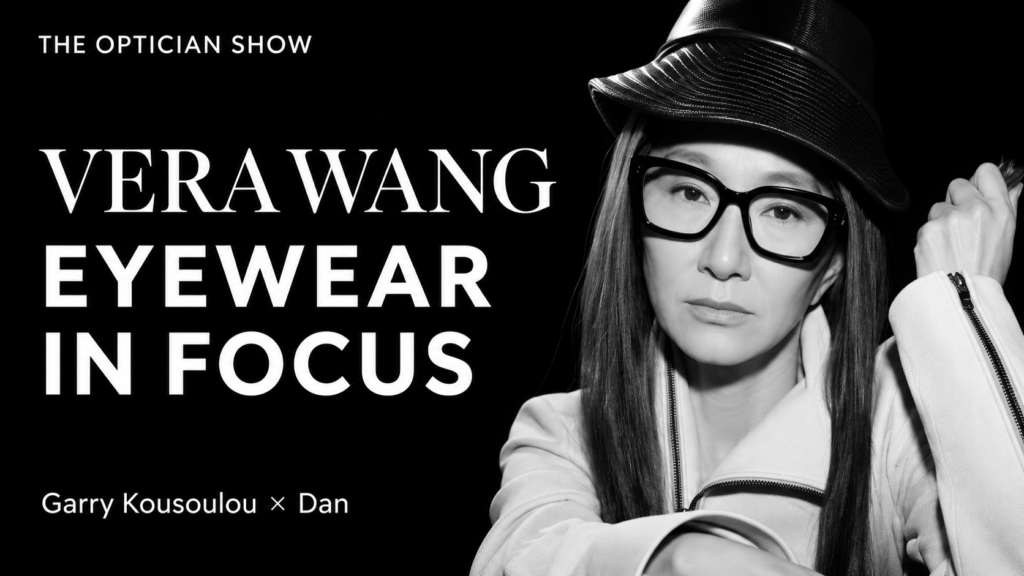
Vera Wang brings a recognisable fashion identity to that conversation. The supplied UK press release describes a collection spanning optical frames and sunglasses, drawing on the designer’s couture background. The campaign photographs supplied with this episode show strong black silhouettes and confident styling. Those images suggest a useful creative direction for a display, while individual frame specifications still need checking.
The name may be familiar to someone who has never bought designer eyewear. That familiarity can create an opening: a patient who knows the fashion brand may be curious to discover its glasses. It does not prove local demand. Your patient mix, existing collections and actual try-on reactions should determine whether the range belongs on your shelves.
My marketing view is straightforward: stock a collection because you can explain its relevance to your patients. If the only explanation is that it is new, the story will soon run out. If the explanation connects a distinctive frame to a patient’s style, comfort and everyday life, your team has something useful to say long after launch week.
02 / THE RANGE
Core, Luxe, Haute and Alternative Fit: understand what you are buying
One of the most helpful parts of the interview was Dan’s explanation of the three main collection positions. The supplied SS26 lookbook adds detail and separately describes Alternative Fit. This distinction matters: a commercial tier tells you where a collection sits, while a fitting option addresses how a frame sits on a person.
| Collection or option | How the lookbook presents it | What to assess in practice |
|---|---|---|
| Core | The entry collection, with modern, sophisticated styling. | Does it fill a genuine style or price gap in your existing selection? |
| Luxe | A more detailed offer, including jewellery-set Preciosa crystals. | Can the team demonstrate the details and explain the individual model’s value? |
| Haute | Italian-made frames; the lookbook describes Mazzucchelli acetates, glitter inlays and crystal detailing. | Check the construction, materials and specification of each selected frame. |
| Alternative Fit | Design considerations for lower bridges, higher cheekbones and fuller faces. | Assess the actual bridge fit, cheek clearance and stability on each wearer. |
Do not turn a detail about one part of a collection into a claim about every frame. In particular, the lookbook identifies Haute as Italian-made. That is not a basis for describing the entire Vera Wang range as handmade in Italy. Equally, a photograph cannot tell you a frame’s exact material, dimensions or prescription suitability.
The lookbook describes a target audience of women aged 32 to 55 and above. Treat that as a supplier’s merchandising starting point, rather than a boundary around who can enjoy a frame. Personal style, fit and patient preference should guide the consultation. Ask to see a varied selection before assuming the collection is only for one type of wearer.

03 / THE BUYING DECISION
How can UK opticians become Vera Wang stockists?
The practical starting point is Atlantic Optical. Its website provides trade registration, subject to approval, and explains that approved accounts can access collections and order. In the podcast, Dan also encouraged interested practices to explore the available material and arrange a conversation with their representative.
Dan said there were no minimum order quantities for the collection. Atlantic Optical’s website also states that it offers no minimum order quantities. This gives a practice room to discuss a focused opening selection. Confirm current prices, delivery, payment terms, returns and any account conditions before deciding what to buy.
I mentioned during the conversation that a small selection of around ten to fifteen frames had sometimes worked well for me. That is an example from my own buying experience, not a prescribed opening order for this range. A smaller practice might need a different approach from a larger destination store. Choose enough variety to make the offer understandable without buying near-duplicates simply to fill a display.
Ask about local exclusivity without assuming it
Dan said Atlantic Optical was open to discussions about local exclusivity. He did not describe an automatic entitlement for every account. If local differentiation is important to your decision, agree the territory, duration, conditions and any exceptions in writing. A friendly conversation is a starting point; it is not the same as a defined commercial agreement.
Bring a buying brief to the appointment
Tell the representative what you already sell, which price positions need attention, what your patients request and which fits you struggle to provide. Ask about replenishment, replacement parts, warranty procedures and lead times. Request model-specific information and the current price list. The meeting should help you decide what to leave out as well as what to include.
04 / THE DISPENSING EXPERIENCE
Great design still needs to work on a real patient
Towards the end of the interview, I asked Dan how he judges a frame after years of handling, designing and working with eyewear. His answer centred on the physical experience: the hinges, temples, nose pads, assembly and the way the frame feels in the hand. It was a useful reminder that the sales conversation should move beyond a brand badge.
My recommendation is to handle the sample as carefully as you would any proposed addition to the practice. Assess alignment, finish, hinge action and adjustment requirements. Then consider how it sits on the intended wearer: bridge contact, temple position, comfort, stability and the relationship between frame shape and lens requirements. A good first impression is useful, but it cannot establish long-term durability by itself.
Where a design has decorative details, show the patient what those details are. Where a frame has a quieter finish, let the patient see that in good light. Explain only the features you can verify for that specific model. This is where dispensing expertise gives the fashion story substance.
Involve the people who will recommend the frames
In the podcast, I argued for getting the whole team involved in frame selection. A receptionist, dispensing optician or optometrist may notice a different patient need from the person doing the buying. Dan also discussed staff and family discounts; ask which arrangements are currently available.
Staff enthusiasm can make a recommendation more natural. It should still be informed enthusiasm. Ask each colleague to choose a favourite and explain who might enjoy it, what they like about the fit and which detail makes it interesting. That creates more convincing conversations than asking everyone to repeat the same supplier description.
“The name opens the conversation. Your team, your dispensing and your marketing give the patient a reason to continue it.”
Garry’s editorial takeaway from this episode
05 / MAKE THE LAUNCH COUNT
How to market a new designer eyewear collection
A new range can arrive with beautiful campaign material and still disappear into the practice. The difference is usually not the size of the launch budget. It is whether the patient can follow a clear path from noticing a frame to trying it on. The following is my recommended marketing approach, rather than a promised result from Atlantic Optical.
Give the collection one clear role
Choose a message that reflects your actual selection. For example, you might introduce distinctive designer frames for patients who want a stronger silhouette, or a fashion-led collection with several levels to explore. Avoid a generic announcement that says only “new range now available”. Explain what has arrived and why somebody should care enough to visit.
Connect the window, website and consultation
Dan described access to campaign assets and point-of-sale support, including larger displays. Ask which materials are available for your account, whether any costs or conditions apply, and how you may use them. The window should introduce the idea. Your website should answer practical questions. The consultation should deliver the experience those materials suggest.
Give the display breathing room. Show a manageable number of frames and a clear invitation to try them. An attractive image beside a crowded, unexplained frame board can leave patients admiring the photograph without knowing what to do next. A simple invitation to book a styling appointment or ask the team for the collection closes that gap.
Make content around the patient’s questions
Use a small set of useful content themes: how a bolder frame changes a look; the differences between selected shapes; what a comfortable bridge fit feels like; and how your team helps somebody choose. A short video showing a colleague’s genuine favourite can be more informative than another slide of product names. Obtain consent before featuring patients and follow the supplier’s rules for campaign assets.
On your practice’s own collection page, describe the frames you actually stock, your location and the appointment process. If you are a confirmed stockist, a natural title such as “Vera Wang glasses at [practice name] in [town]” can make the page’s purpose clear. Replace those details with accurate business information and write for the person searching. Repeating a town or brand name in every paragraph makes the page harder to read.
Use attention, interest, desire and action thoughtfully
The familiar AIDA sequence is useful as an editing check. A striking campaign image earns attention. A relevant patient question builds interest. A convincing explanation of fit, style and service helps someone imagine wearing the frame. A specific next step makes action easy. The sequence should make the content clearer; it should never require exaggerated claims, pressure or invented scarcity.
Storytelling can do similar work. Begin with a recognisable situation: somebody wants glasses that feel more like them but keeps choosing the safe option. Show how a thoughtful try-on appointment helps them explore. Let the practitioner’s expertise and the wearer’s preference drive the story. You do not need to promise a transformation to make an ordinary, satisfying decision engaging.
A practical first-month launch plan
- Week one: choose and prepare. Review samples against your buying brief. Confirm terms, select the opening range, train the team and organise approved imagery. Decide how enquiries and sales will be recorded.
- Week two: introduce the collection. Update the display and publish a useful collection page. Show two or three team favourites on social media. Give every post a clear route to a conversation or appointment.
- Week three: answer real questions. Turn enquiries into content. Explain a fit question, demonstrate a frame detail or show how your team compares styles. Invite suitable existing patients through the communication channels they have agreed to use.
- Week four: review the evidence. Compare enquiries, try-ons, appointments and sales. Identify the frames patients notice but reject, and record why. Discuss replenishment or changes with the representative using those observations.
Look beyond likes and views. Track which enquiries become appointments, which try-ons become purchases and whether the selection supports the margin your practice needs. Evaluate the complete dispensing outcome, including lens choices and service time, rather than celebrating a frame sale in isolation. If interest is high but sales are weak, investigate fit, availability, pricing clarity and team confidence before ordering more stock.
What makes this a credible guide rather than another brand announcement?
This article draws on an original interview, the supplied UK launch press release, the SS26 lookbook and checks of the distributor’s public information. Where Dan described patient reactions, those remain his reported experiences. They are not independently measured evidence of how the collection will perform in your practice.
My recommendations combine the dispensing perspective behind The Optician Show with the marketing work of Loving Social Media. They focus on useful decisions: who the frames suit, what the supplier supports, what the team can explain and how the launch will be measured. That is more helpful to an optician than a string of superlatives.
For search, the same discipline matters. Clear authorship, specific answers and visible sources help readers assess an article. Google’s guidance encourages content that serves its intended audience and makes its creator’s background clear. E-E-A-T is a way to think about credibility, not a label you add to a page to secure a ranking. Structured data should describe the actual article and cannot promise visibility in search or AI answers.
06 / QUESTIONS FROM OPTICIANS
Vera Wang eyewear stockist FAQs
Who supplies Vera Wang eyewear to UK opticians?
The supplied UK launch release and SS26 lookbook identify Atlantic Optical as the UK distributor. Contact Atlantic Optical to discuss trade access, current collection availability and support for your practice.
Is there a minimum opening order?
Dan said in the interview that there were no minimum order quantities, and Atlantic Optical’s website states that it offers no minimum order quantities. Confirm the current conditions and account terms directly before placing an order.
Is all Vera Wang eyewear made in Italy?
The supplied lookbook identifies the Haute collection as Italian-made. That claim should not be applied to every Vera Wang frame. Ask for the materials and country-of-origin information for each model you are considering.
Can my practice have local exclusivity?
Dan said exclusivity discussions were possible. Availability depends on an individual agreement; it is not guaranteed. Ask Atlantic Optical to confirm any territory, duration and conditions in writing.
What marketing support should I ask for?
Ask about approved campaign photographs, window and in-practice displays, digital assets and staff support. Confirm availability, costs and usage permissions for your account before building a launch around them.
How do I decide whether the range will sell?
Review patient demand, fit, your current frame mix, purchase costs and retail positioning. Start with a considered selection and measure enquiries, try-ons and sales. The interview offers useful insight but does not predict an individual practice’s results.
YOUR NEXT MOVE
See the frames.
Ask better questions.
Plan the launch.
If Vera Wang could fill a gap in your practice, arrange a proper look at the collection. Bring your team into the decision and ask Atlantic Optical for current trade details, sample access and marketing support.
Speak to Atlantic Optical ↗Trade enquiries: info@atlanticoptical.co.uk · 029 20 362136
Want help making a new frame collection visible through your website, social media and local marketing? Talk to Garry at Loving Social Media about a launch built around your practice and your patients.
Discuss your practice marketing →Sources and editorial context
Prepared from The Optician Show conversation between Garry Kousoulou and Daniel A J Smerald, together with the supplied Atlantic Optical UK launch press release and Vera Wang SS26 lookbook. Supplier statements describe the collection and arrangements discussed; current commercial terms should be checked directly.
- Primary interview: supplied podcast transcript, The Optician Show — Garry Kousoulou with Daniel A J Smerald.
- Supplied documents: “Atlantic Press Release_Vera Wang June 2026” and “Vera Wang SS26 AO Look Book”. Campaign photography supplied with the episode.
- Atlantic Optical: trade registration, ordering and support information .
- Atlantic Optical: current public contact details .
- Google Search Central: helpful, reliable, people-first content .
- Google Search Central: structured data guidelines .
The interview guest represents the supplier and has a commercial interest in the collection. The marketing recommendations are editorial guidance. No award win, future product launch, guaranteed exclusivity or guaranteed sales result is asserted here.